Managed Kubernetes
Concepts
Discover the fundamentals and essential principles to master our infrastructure.
Explore concepts →Getting Started Guide
Get up and running quickly by following clear and simple instructions.
Launch Quickstart →Tutorials
Learn step by step how to configure and use our services with detailed guides.
Discover tutorials →Managed Kubernetes by Cloud Temple is a container orchestration solution based on open source standards (CNCF). It is designed to provide a high level of security, resilience, and automation on Cloud Temple's SecNumcloud platforms. Each cluster is deployed in a Cloud-Temple IaaS environment fully dedicated to the client.
To best meet your teams' needs, we offer two versions of this product: Managed Core Kubernetes (a minimal base) and Managed Kubernetes (a complete "out-of-the-box" platform).
Two approaches for your clusters
1. Managed Core Kubernetes (Le socle minimaliste)
This offering is designed for teams with excellent Kubernetes expertise and Cloud Native tools, who wish to build their own platform on minimalist and robust foundations. It targets open source enthusiasts looking for a streamlined, portable solution without vendor-specific overlays, running on a minimalist and immutable OS designed for automation and security.
- OS and Networking included : Talos OS, Rook-Ceph (stockage), Cilium (CNI), MetalLB (Load Balancer).
- Philosophy : Starting from this high-performance and standardized foundation, you are free to integrate your own continuous deployment, observability, backup, or security tools.
2. Managed Kubernetes (La plateforme complète)
This turnkey offering is designed for teams seeking a native, out-of-the-box, and all-in-one solution, integrating the best open-source standards to cover all application lifecycle needs without having to assemble and maintain the components themselves.
In addition to the "Core" foundation (Talos, Ceph, Cilium, MetalLB), it natively integrates:
- Networking and Security : Hubble, Ingress Nginx, Kyverno, Capsule, Cert-Manager.
- Continuous Deployment (GitOps) : ArgoCD, Harbor Container Registry, Keda
- Observability : Full stack (Prometheus, Grafana, Loki, Pyroscope).
- Cost Management (FinOps) : OpenCost.
- Backup and Rollback : Veeam Kasten.
- Identity : SSO authentication with an external OIDC Identity Provider (Microsoft Entra, FranceConnect, Okta, AWS IAM, Google, Salesforce, ...).
Common Key Benefits
Regardless of the chosen offering, our Kubernetes clusters share these fundamental benefits:
- Sovereignty and Reversibility : The solution relies on open source standards to avoid any technological dependency (vendor lock-in) and guarantee full portability of your applications. (With Veeam Kasten included in the full version to facilitate inter-cloud migrations).
- "Zero-Trust" Security by design : The architecture is built on Talos OS, an immutable and ephemeral Linux operating system specifically designed for Kubernetes. It provides no direct access (neither shell nor SSH), which drastically reduces the attack surface.
- Cost Control : The pricing model is transparent, based exclusively on the underlying consumed IaaS resources, with no additional licensing cost for the orchestrator.
Deployment Architectures
We offer two distinct architectures to meet your needs, whether for development environments or critical production environments. These architectures apply to both offerings (Core et Full).
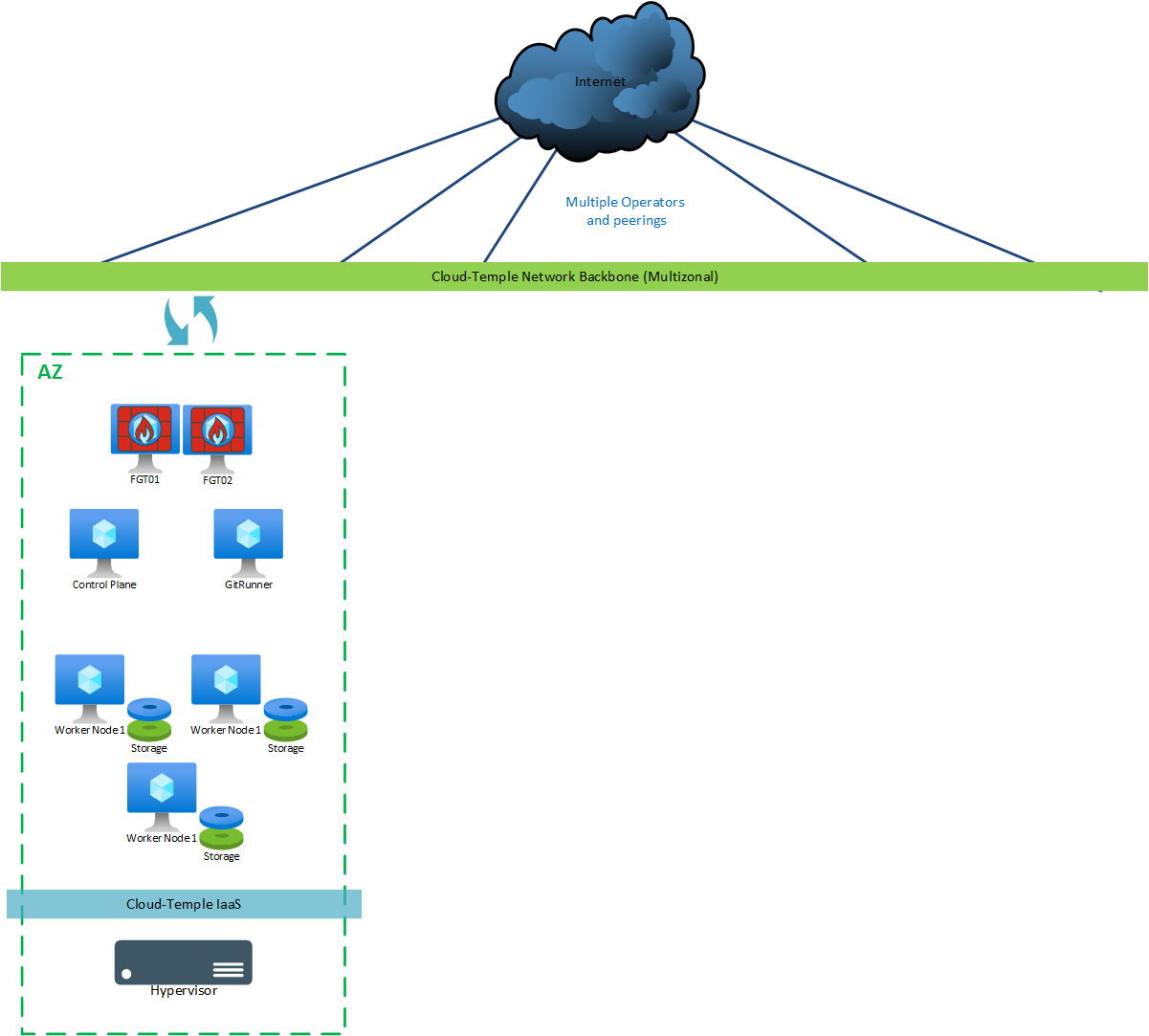
"Dev/Test" Architecture
Ideal for POC environments, this compact architecture deploys all resources within a single availability zone (AZ).
- Use case : Development, testing, proof-of-concept (POC).
- Key points :
- 1 Control Plane node.
- 3 Worker nodes (or more).
- Distributed storage (Ceph) is co-located on the worker nodes.
- Does not provide a high availability SLA.
- No architecture-specific security restrictions.
Production Architecture (Multi-AZ)
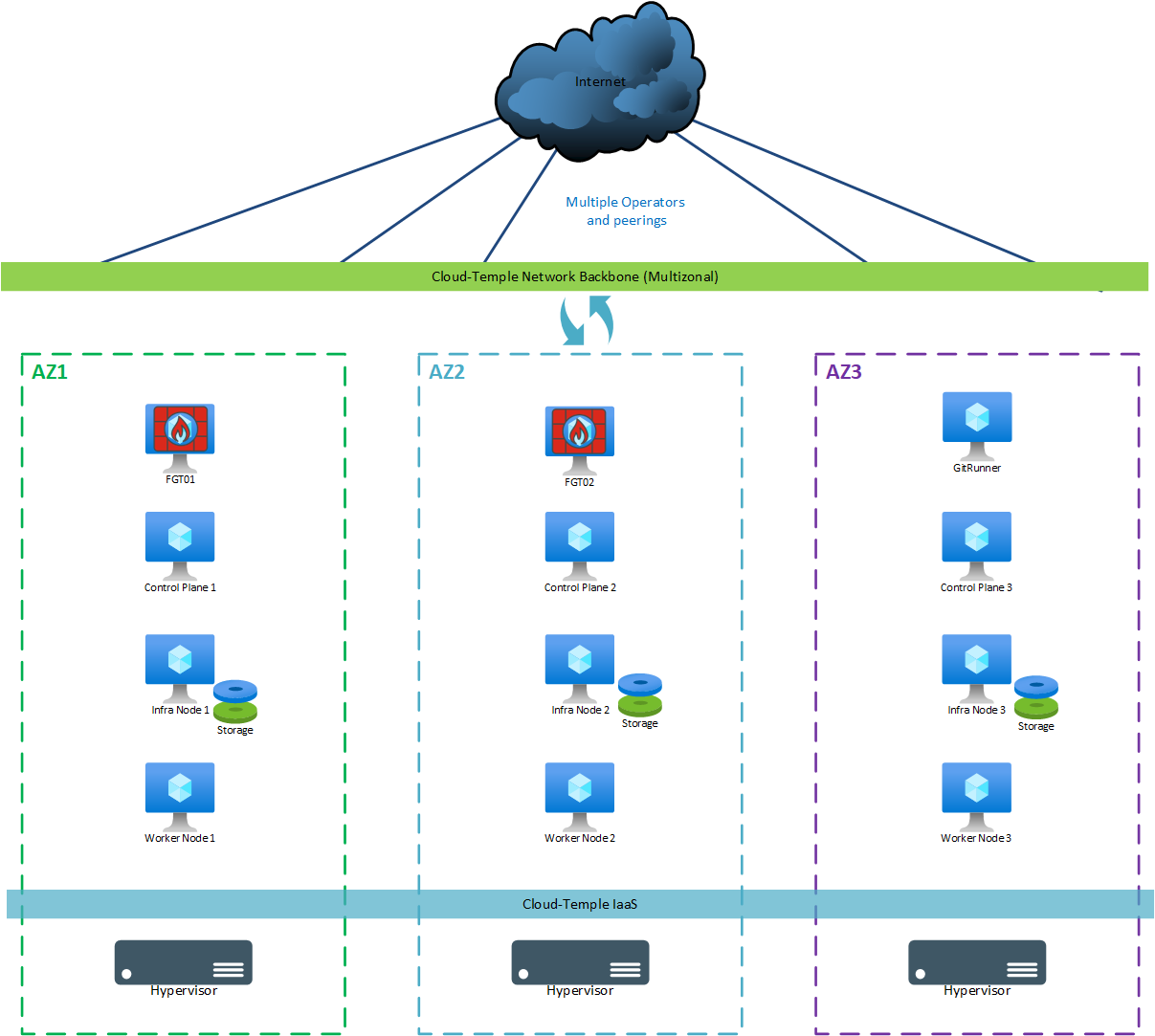
Designed for production and critical applications, this architecture distributes resources across three availability zones (AZ) to ensure high availability and maximum resilience, in compliance with SecNumCloud requirements.
- Use Case : Production applications, critical services, platforms requiring an SLA.
- Key Points :
- High Availability : 3 Control Plane nodes distributed across 3 AZ.
- Dedicated Storage : 3 dedicated and distributed storage nodes for performance and resilience.
- Distributed Workers : At least 3 worker nodes, one per AZ.
- Bare Metal Nodes (Optional) : Possible integration of "Bare Metal" type worker nodes for specific performance needs, particularly GPU support.
- 99.95% SLA, measured monthly.